Genre and Tone.

Learning Outcomes:

-To look at a range of texts in order to understand how writers set a tone and write for a particular genre.

-To find out what genre conventions are and how we recognise them.

-To understand how an author portrays the tone through use of language.


Exercise:

“It was almost midnight…”

  1. It was almost midnight and I still hadn’t finished everything on my to-do list, if I don’t finish everything by tomorrow only God knows how I’ll be able to get through the day.
  2. 23:45pm, it was almost midnight and he still hadn’t turned up, he promised? How could he let me down again…
  3. It was almost midnight, I’m nearly 16! I can’t wait I’m so excited! I wonder what Mum and Dad have bought me.
  4. The day was coming to an end, it was almost midnight and I had to be up by 7:30am the next morning, but yet, I still couldn’t sleep.
  5. It was almost midnight, I only have 10 minutes until the deadline and I’m still writing my essay! This essay counts for the majority of my grade I have to get it perfect.
  6. After three long weeks they’re finally nearly here, its almost midnight! I can’t wait to see them.
  7. It was almost midnight when I noticed the porch light come on, was someone outside? I’m home alone…
  8. It was almost midnight! 10! 9! 8! 7! 6! 5! 4! 3! 2! 1! HAPPY NEW YEAR!
  9. It was almost midnight and he just kissed me. I couldn’t believe it. Everyone had left the party already and I was just getting my jacket and there he was and he kissed me.
  10. It was almost midnight, tomorrow’s the big day. I wonder if he’s doing okay, I’m so nervous.


Writing Task:

Romance… 

As I lay there in silence, the sound of the gushing waves hitting against the shore soothed me. The air was warm and the sun was turning in for another night. Paradise. There he lay to my right, his hair moving with the breeze, how could someone be so beautiful while they slept? As I watched the water move back and forth, allowing the sand to dry then suddenly drowning it all over again in an instant, I watched in awe.

Historical…

Single file the woman said. We walked slowly, trying to take in all of the scenery, the rocks were slippery and my backpack was heavy but every second of the discomfort was worth it. I looked to my left and had the sudden urge to freeze, there it was, Niagara Falls. The power of that water rushing down with such force but still managing to look so beautiful, I couldn’t comprehend what my eyes had just witnessed. Even the sound was beautiful, it echoed for miles.

My 10 personal fears:

  1. Losing my family
  2. Being alone
  3. Feeling constantly anxious
  4. Not really ever knowing my purpose in life
  5. Dying
  6. Feeling the pain of losing someone I love again
  7. Fear of not being understood
  8. Being in a horrible accident
  9. Black bin bags
  10. Being abducted


Writing Task:

I was running and running and running and yet I still felt like I was still there. My heart pounding so fast I could feel it all over my body, I could hear it so loud in my head. I was panting for air but I couldn’t stop, if I stopped I would die, I know I would. He wasn’t far behind me, I could hear him calling out my name, taunting me. Every time I hear my name now, I flinch. It’s been 17 days and I still haven’t slept longer than 10 minutes at a time, I’m scared that he’s going to find me and take me back there I can’t go back there I won’t go back there I won’t do it.


Evaluation of the session:

In this session we took a sentence “It was almost midnight…” and had to write 10 different sentences from that sentence starter, we then done a writing task where we explored different genres and wrote short stories within those genres, I chose romance and historical. After that I wrote a list of my 10 personal fears in order to explore and find out where fear lay inside of my mind, I then wrote a short story in the mind of one of those fears. By doing these tasks and finding these fears it has allowed me to open my mind to another page and allow my creative side to write about things that haven’t happened directly to me but can grow from something I fear. I still need to develop in finding different styles of writing and being able to write about new things using those styles. I believe that a lot of my writing is influenced by my personal pain or experiences and I want to challenge myself to be able to use that pain but still be able to write about something positive and constructive.
Building A Character.

She stands on the pathway of Braodway as hundreds of people push past, some tourists, others mainly busy people rushing back to work. The air smells of hot dogs and pizza along with the thick musk of New York air, the slight scents of perfumes and aftershaves all blended together flowing through the air.

Scarlett wears a baggy t-shirt with a short black puffa jacket on top, combat trousers and a new pair of white airforce trainers. Her hair, the darkest of browns and wavy, scrunched up into a messy bun, something she threw together in the morning. No make up for her face, just the slightest of mascara to highlight her favourite feature, her eyes.

Even though she’s surrounded by  people, Scarlett still manages to feel alone. Is it the absence of her deceased brother that allows her to feel this emptiness, or is it the everlasting longing of trying to find her own feet and where she stands in this world that leaves her feeling as if she’s sat in an empty glass box as people stand around outside looking in.


(To be continued)

Show And Don’t Tell.

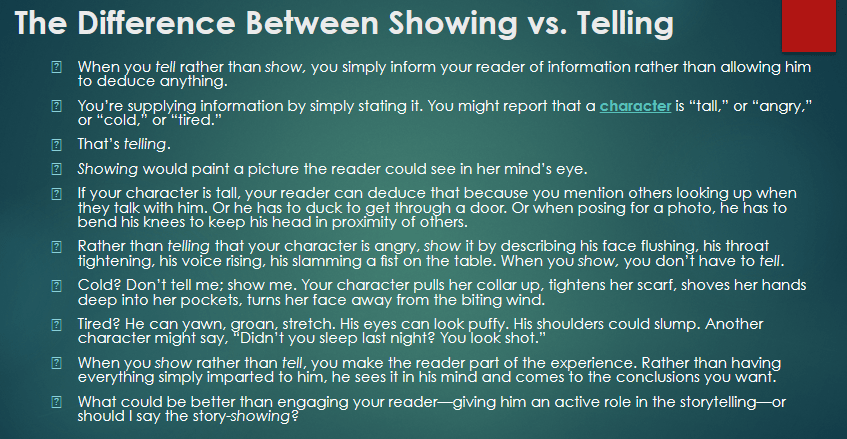
Although there is a place for both showing and not telling, the general rule in Creative Writing is “Show, Don’t tell.”

Showing:

-Is human-centred

-Is a slower, richer, more expansive way to communicate

-Loves detail, can often stir the heart

Telling:

-Is factual and brief

-An efficient way to communicate data

-Is not human-centred and as a result doesn’t generally stir the heart

Show and dont tell

Show and Don’t tell exercise:

Develop these from Telling to Showing..

-Johnny was a good musician — Music ran through Johnny’s body like the blood through his veins.

-Sally was happy — The smile on Sally’s face brightened the whole room

-He was angry — Red was all he could see, vengeance was all he could think of, rage was all he felt

-It was hot — The sun shone down onto the people taking no prisoners, the air was thicker than meat loaf

–Agnes was impatient — The hands on the clock seemed to be moving slower than an old person with a walking stick, my leg shaking from the nerves of the wait


Character, Plot and Setting.

Learning Objectives:

-Explore and understand the ingredients/characteristics of narrative devices: character, plot structure and setting.

-Hero’s Journey: what is it and how does it work to make a good character?

-How does this affect the style of writing and choice of narrative?

-Character questions to ask yourself and character

-Setting: place you love and hate

-Setting questions.

-Show and don’t tell.

To Demonstrate an understanding of how to build a character and how this effects the style of writing. Write in any form exploring a character, setting and plot: short story, script for film or theatre or radio, beginning of novel, poem or journalistic (non-fiction) article.

What Character’s Need!

-The most important ingredient in any story is character/s is to understand what a character needs.

-Your job is to make attaining this need as difficult as possible by introducing conflicts and drama into the story.

-At the end of a story the need is either fulfilled or denied.

-The character needs to have changed from the state they begun the story in. This is the characters arc.

Hero’s Journey: 

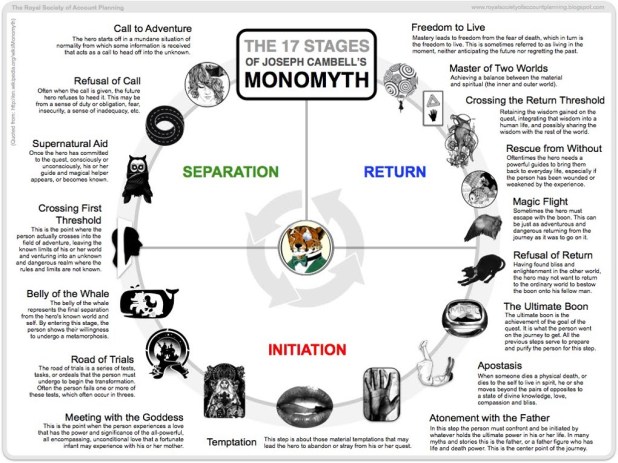
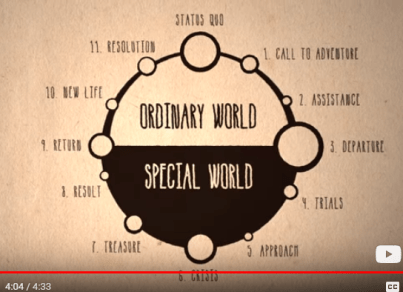
Every story follows or uses the same tropes that have been used for generations: The mono-myth or Hero’s Journey.

In narratology and comparative mythology, the mono myth, or the hero’s journey, is the common template of a broad category of tales that involve a hero who goes on an adventure, and in a decisive crisis wins a victory, and then comes home changed or transformed.

heros journeyheros journey 2

My Journey..

-Going into year 11 and having a hard time focusing

-Uncle Pete dying suddenly and having to go to Cyprus for 2 weeks for the funeral

-Coming back to England and getting into a fight and getting arrested with my sister

-Getting out and having to sit my exams the next day

-Struggling to find myself and be okay again

-Moving out when I was 16 to live on my own with my sister

-Eventually being left on my own and having to work and find my own way

-Having Ed as a mentor/companion along the way

-Taking a huge leap to leave my job and move from Enfield to Canterbury and leave behind everything and everyone I knew

-Getting into Canterbury college to further my education and better my life


What makes a good character?

-How does this affect the style of writing and choice of narrative?

-Perspective, tone, word choice and genre .


Character/ Story sections:

Needs – Themes : money/freedom/justice/love/fitting in/ power/equality/revenge

Conflicts/Obstacles – power/political/antagonist/villains/health/internal & external conflicts/natural disasters/environmental issues.

Fulfilled = happy ending / Denied = sad ending.

When reading a story you don’t instantly love one character, it’s a journey and over time you relate and emotionally connect to a character as you see them grow and over come things as they develop. You see a character that has done things wrong and has flaws but also has good intentions so you see them growing and you have an emphatic understanding as to why they have done what they have done. This makes them original and unique as a character. At some point in the story they over come something that makes them extraordinary by going through extraordinary circumstances. The author makes each character relateable be it either the villain or the main character or a side character that has an affect on the other characters. By setting a tone in a story, helps your reader to understand the bigger picture and have a better perspective on the story line.

Reading Sheet Extracts:

The first extract is very vague and entices you into wondering who the man who’s being described is. The description of the man is very detailed and makes you question why the writer observed this man so closely. It leaves you wondering what is going to happen or what has happened.

In the second extract, it’s a man talking to the reader, making it personal and giving a list of things about himself, in a way trying to sell himself, a very desperate approach. The speech is very light hearted with a sly sense of humor behind what he’s saying. The character is clearly insecure and this can be detected by what he says about himself in his short paragraph. The writer uses the word ‘red’ quite frequently and this could suggest connotations of maybe murder or danger in the future of the story, by implanting the word and colour red into the readers mind they are then open to suggestion of disaster.

The third extract has an emotional feel to it and leaves the reader with a lot of questions. We understand that it is a girl who is talking as she starts off with “he was the most special friend a girl could have”. The girl continues to think back while talking about Briggsy and the reader begins to understand that she is quite sad about what she is saying about this other character. Her short sentences suggest that she’s talking about this other character to someone maybe at a funeral or a therapy session. She is also speaking in past tense which allows us to understand that something has happened in order for her to be speaking and feeling this way.

All three of the extracts are interesting, personally I believe that the third extract leaves the reader with the most questions and entices the reader to want to read more. The second and third extract have more of a personal feel to them as the characters are speaking about themselves or about an emotional connection whereas in the first extract, I feel that it had more of a story vibe which can also bring the reader in to question what happens next. Each author may have been influenced by personal life events in order to write such descriptive pieces or maybe they just have a wide imagination. In the second extract written by Hornby who is also a man, he may of been writing about himself or someone that he knows for his writing influence. In the third extract written by Dewar who is a woman, she could be portraying her feelings about having lost a love one through the character she’s writing about.

The choice of language differs in each piece. In the first extract we get a very detailed and descriptive insight onto a character with sentences very story-like. In the second extract we have a more light hearted, bantering perspective, as if the character themselves is talking to us. In the third and last extract we have a very deep heartfelt approach with short sentences suggesting that the person speaking is chocked up by what they are saying as its emotional and upsetting to say. Each extract has a different intention for the reader as they are each written in different ways.


muhammad-ali-fights-sonny-liston.jpg

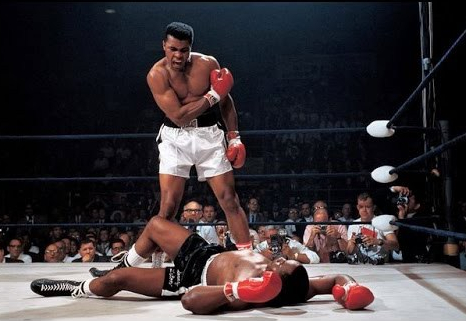
Muhammad Ali fights Sonny Liston, February 1964.

In this image we see Muhammad Ali, previously known as Cassius Clay before converting to Islam, standing over opponent Sonny Liston during their boxing match in 1964. Muhammad Ali stands over Sonny Liston with an expression of anger and a stance of power. As Muhammad Ali was victorious in this fight, this picture symbolizes success. It could be seen as a motivational picture and can give someone the confidence to fight their battles face on.

The fighters had two fights together, competing for the boxing World’s Heavyweight Championship. These fights were among some of the most anticipated, watched and controversial fights in sports history. At the time this fight took place, Muhammad Ali was still going by the name Cassius Clay. Their first fight was held in Miami Beach Florida in February 1964, where Mr Clay, later Mr Ali, won at the opening of the seventh round after giving Mr Liston a hard time in round six. A year later in 1965, their second fight took place in Lewiston, Maine, where Mr Ali won with a first round knockout.


Short Story Scene:

I walked past my posters daily, but on this particular day, only one stood out to me. The legendary Ali vs Liston fight. Seeing Muhammad Ali standing over Sonny Liston with that fire in his eyes, the look of hunger, not taking no for an answer, it inspired me. They weren’t just fighting, they were creating history while doing what they loved. Day by day I grow to resent my school and the people that go there. The smug look on Alex’s face as he received his math’s test back, probably starring at another A. Then there’s me, receiving another C, average, nothing special, my parents are getting worse at pretending it’s good enough for them. I know I can be better, I know I can push myself and focus and hopefully get an A for the next test, I just get distracted too easily. Standing here at 8:17am looking at the power Ali holds as he stands over Liston, that’s the power I want, that’s the power I’m aiming for. Oh, how I would love to see the look on Alex’s face when it’s me that look’s at my test paper with pure smugness. My parents wouldn’t know where to hide their surprised faces. “How did he pull this off?” they would mutter to one another as they walked away in amusement. The next test is Monday morning, that gives me four days to get my head down and prove everyone wrong. I WILL win this fight. Just like Muhammad Ali did. Right, 8:19am now, better get going before I miss the bus, that wouldn’t be the best of starts to my victory now would it.

Story Telling.

Tuesday 25th of September 2018.

Learning Outcomes:

-Being able to establish an understanding for what readers look for in a newspaper/magazine.

What do you read about in a newspaper?

  • things that effect the reader
  • election
  • crime
  • human-interest
  • conflicts
  • up-lifting
  • celebrities
  • sports
  • natural disaster
  • war
  • environmental issues
  • economy
  • business
  • science
  • discovery
  • politics

Breaking down a sentence into one constructive word:

7 – creativity, a free mind and a colourful agenda.

6 – creativity, free mind’s and colourful agenda’s.

5 – creativity, freedom and colourful criteria.

4 – creativity and freedom, expand.

3 – creative freedom, explore.

2 – creatively free.

1 – creation / freedom.


In this session we learned how to take a headline and gradually break it down to one word that would capture the audiences attention instead of having to read the whole sentence. I struggled breaking the sentence down and deciding which words I should remove in order to have the best affect on the reader but eventually I achieved the intention of the exercise. I know now that I can use less words to have more of an impact to capture the readers attention rather than trying to have a whole headline to draw them in.

Creativity, a free mind and a colourful agenda.

Introduction: 

To create a heading that would catch the eye of someone looking for a media/journalism course, then write an intro to approach them.

Are you a writer? I have a strong feeling that you love writing, if so, open your mind to all the possibilities that this course can offer you. The chance to expand your knowledge and skills to the level of professionals. If you ask me, that sounds pretty appealing. Sharing a classroom with minds on the same path as your own, imagine all the conversations you would have, the possibilities are endless!

Evaluation:

In this session I had to come up with a headline that would draw someone in to choose this course and then write an introduction into the course to entice them in. I found this interesting to do as I had to put myself in the mind of someone who writes course introductions to bring students onto the course. It was a fun challenge to do.

Design a Web page.

Monday 24th of September 2018.

Learning Objectives:

-To design a web page based on research and experience / shared knowledge of effective and well regarded sites.

-Evaluate: what makes a good/bad website – the copy?

-Research, Analyse & Develop their own ideas of an effective website.

-How to recognize visual mediums and how words compliment / add to the visual.


Websites: 

  • twitter.co.uk
  • missselfridge.co.uk
  • topshop.co.uk
  • amazon.co.uk
  • facebook.com
  • instagram.co.uk


Make sure that you understand your target audience and create an ad that answers what they’re struggling with.

What can we sell?

-products

-services

-events

-information

-ideas/politics/opportunities

-image

-life style

Copy writing.

A copywriter is someone who provides the words used to sell or promote different products, services, ideas and even people.

-The paragraphs should flow nicely to capture the audience.

“Consumers do not buy products, they buy product benefits.”

As a Copy Writer ask yourself, “What are their habits, language, style, persuasion methods?” “Who is going to buy your product?” “What are the particularities of the audience.”

The Headline.

“On average, five times as many people read the headlines as opposed to the body copy.”

-The headline is the most important part of your copy. It’s how you capture their attention in the first place.

-Use numbers because readers love lists.

Exercise: 

PRODUCT – Nike “Just do it.” Netflix “See what’s next.”

SERVICE – Asda “Every day low prices.” BT “Be there.” Job Opportunities “Apply online for your dream job.”

IDEA – “Kavanaugh accuser agrees to testify in senate hearing.”

Simile Destruction:

GOAL: Eliminate cliches from your content

HOW TO: Create a list of tired cliches – working like a dog, happy as a clam, strong as an ox.

Common Cliches:

-Actions speak louder than words

-The apple doesn’t fall far from the tree

-What doesn’t kill you makes you stronger

-Love is blind

-Don’t judge a book by it’s cover

-Until the cows come home

-Take the bull by the horns

-Fit as a fiddle

-Every cloud has a silver lining

-Ignorance is bliss

-Leave no stone upturned

-Easy as pie


Similes: 

-As brave as a lion

-As easy as ABC

-As good as gold

-Happy as a clown

-Hot as hell

-Hard as nails

-As mad as a hatter

-As solid as a rock


Breaking a simile/cliche:

-As round as a roundabout

-As strong as the worlds strongest man holding up the world

-As wise as an owl who just got out of med school

-As old as your grandparents and all their friends, combined

-As good as eating a cake after a long diet


“Get it down. Take chances. It may be bad, but it’s the only way you can do anything good.”

Journalism.

Aims and Objectives:

-Discuss and identify the main characteristics.

-Discuss and define the essential skills, craft and aptitude of a journalist.

-Discover and analyse the ‘ground rules’.

-Demonstrate some of the skills, craft and aptitude.

  • carry a pen/pencil and pad at all times
  • enjoy writing
  • keep a journal/diary
  • carry a camera around

Tips&Tools:

-Remember to always refer back to the interviewee. Do not, under any circumstances tell lies, twist the story and make up your own side of the story.

-Expand your vocabulary. Read the daily newspaper. Purchase a nice dictionary and thesaurus.

What makes a good journalist?

  • persistence
  • curiosity
  • toughness
  • an eye for a story, an ability to write a sense of fairness
  • the ability to grasp the big truths – with the humility to let them go again when the facts don’t fit.

THE FIVE W’S.

WHO    WHEN    WHAT   WHERE   WHY

Ground Rules For Writers:

-Use specific words (red and blue) not general ones (brightly coloured)

-Use concrete words (rain, fog) rather than abstract ones (bad weather)

-Use plain words (began, said, end) not college educated ones (commenced, stated, termination)

-Use positive words (he was poor) not negative ones (he was not rich) – the reader at once wants to know, how not rich was he?

-Don’t overstate : fell is starker than plunged. 

ANALYSE. 

Examine (something) methodically and in detail, typically in order to explain and interpret it. “We need to analyse our results more clearly.” Synonyms : examine, inspect, survey, scan, study, scrutinize, look over.

EVALUATE.

Form an idea of the amount, number, or value of; assess. “The study will assist in evaluating impact of recent charges.” Synonyms : assess, assess the worth of, put a value/price on.

REFLECT. 

Think deeply or carefully about. “He reflected with sadness on the unhappiness of his marriage.” Synonyms : think about, give thought to, consider, give consideration to, review, contemplate.


Short Story:

In a world full of loneliness and abandonment, I look to you for guidance. I follow you around like a lost puppy, hoping to just go home. Your scent softens my nostrils with the sweetness of cherries from your perfume. Your smile is brighter than a summers day in Spain. Your presence can make the saddest man feel like the luckiest in just under 5 minutes, in this case that was me. How can I ever explain why I killed you?


Evaluation:

In this week that there are different types of writers I could be, different areas to focus on and this intrigues me. I would like to learn more into journalism to expand my knowledge for the future. I am interested in reading more news articles and magazines to get more of an understanding of how people professionally word their sentences and form their paragraphs. This would be good research for me and a good insight into the world of journalism.

From the exercises we completed in today’s session, I have a better understanding of the ground rules for writers and what makes a good journalist. Also defining the differences between Analyzing, Evaluation and Reflection.

Why I Write.

I write to free my mind. I write so that I can put my thoughts onto paper. I write to understand myself. By putting pen to paper, I’m allowing my hand to turn my thoughts into words and sentences. I’m able to create another world, by stepping out of my reality and stepping into a land of the unknown. Being able to find and create something beautiful. I write so that I can escape.

I write to give people freedom that I so crave, by reading words that create images and thoughts in your mind that take you to a place of distraction. I write to free my mind also, from my pain and my overthinking. It’s truly amazing what one can create just by placing one word next to another and then that leading to a sentence that someone could read and connect and relate to. That is powerful. That is why I write.


Evaluation: 

In this session I explored the question ‘Why I Write’ and gave my insight into why I personally write. I found this quite important for me especially as a writer because it allowed me to explore my mind and figure out and write down why it is I am a writer.